Spiritual, Moral, Social and Cultural
Creative Arts
Spiritual development in Creative Arts
The Creative Arts provide students with the opportunity to develop a sense of spirituality through the experiences and emotions generated during the creative process. Students are encouraged to explore their spirituality by creating original pieces of music, art, and drama. This exploration allows them to experience a sense of personal achievement when presenting their work and engage with subject matter that requires introspection and empathy for others. Through the act of creation, students delve into their inner selves, exploring their beliefs, values, and emotions. They learn to express complex feelings and ideas, often finding personal meaning and connection in their artistic endeavours. This process can be deeply fulfilling and spiritually enriching, fostering a greater understanding of themselves and the world around them.
Moral development in Creative Arts
Creative Arts subjects encourage students to express their own responses to moral dilemmas and emotions. They gain an appreciation for the work of practitioners in highlighting issues of unfairness and injustice, as well as discussing moral dilemmas and the artistic expression of what is morally right. Critical discussions in response to challenging artworks, plays, and music are integral to learning and development, fostering a deeper understanding of moral complexities. By examining and creating works that tackle themes of right and wrong, students are encouraged to think critically about their own values and the impact of their actions. This process helps them develop a nuanced perspective on ethical issues, enabling them to articulate and defend their views while respecting differing opinions.
Social development in Creative Arts
Music, art, and drama are inherently collaborative and social subjects. Working collaboratively is a fundamental aspect of learning within the Creative Arts department. Group activities require students to share, refine, and discard ideas through cooperation and sensitivity to the feelings and opinions of others. Performing and presenting in front of audiences during lessons enhances their ability to interact with others in various ways. Extra-curricular activities, such as school productions, workshops, choirs, concert bands, rock groups, and drama clubs, offer numerous opportunities for students to collaborate, meet new people, and create art with like-minded individuals. These activities help students develop important social skills, such as communication, teamwork, and leadership. They also foster a sense of community and belonging, as students work together towards common goals and share in each other’s successes.
Cultural development in Creative Arts
The curriculum in the Creative Arts department is broad and comprehensive, allowing students to explore music from the British Isles and around the world. This includes Western classical music, a diverse range of 20th-century music (such as rock, pop, film music, jazz, minimalism), and world music (including African drumming, Indian music, and Latin American styles). In drama, students study texts and dramatic art forms from various cultures, fostering connections between different cultures and their own. In art, students explore a variety of past and present practitioners in discovering their own means of expression. This cultural exploration helps students appreciate the richness and diversity of human creativity, encouraging them to see the value in different perspectives and traditions. It also helps them develop a global outlook, understanding how cultural exchange and interaction have shaped the arts and continue to do so today.
Extra-Curricular Activities
These activities promote democracy, free choice, adherence to rules and guidelines, and cultural exploration. Examples include independent use of school resources, responsibility for equipment, school productions, student-led concerts, Christmas events, drama clubs, and other extra-curricular events. These activities contribute to citizenship development through engagement with other cultures and beliefs. They also provide a platform for students to practise and reinforce the values learned in the classroom, helping them become well-rounded and responsible individuals.
Design and Technology
Spiritual development in Design and Technology
Design Technology
Spiritual development is of a very high importance in design & technology. The process of creative thinking and innovation inspires students to bring out undiscovered talents, which in turn breeds a self-confidence and belief in their abilities. It also challenges and appeals to the creative instincts that have driven humanity to discover, adapt and overcome. Within our schemes of work, we seek to develop these.
Food and Nutrition
Students are provided with the opportunity to participate in making and evaluating food from other countries learning about others from the world around them. They are exploring government guidelines for healthy eating and dietary requirements to make healthy life choices.
Students are offered feedback and assessment that values their effort and achievements.
Mutual respect is developed through the process of peer evaluation of each other’s work and standards. A pupil’s ability to self-reflect is developed through self-assessment.
Both classroom and practical based lessons in Food offer pupils the opportunity to reflect on their experiences, use their imagination and creativity when cooking.
Moral development in Design and Technology
Moral development: In design & technology we seek to develop a sense of ‘moral conscience’ in our students, through focusing upon the moral dilemmas raised in designing and making new products. We teach students to understand the wider impacts on the environment when designing and making new products and expect them to carefully consider the materials & components they will use when designing and making. We encourage sustainable thinking through the active application of the ‘6 R’s’ and to highlight the impact on environmentally sensitive areas of the world. The 6 Rs include: reinvent/rethink, refuse, reduce, reuse/repair, recycle, replace/rebuy.
Impact on society: Not all products are designed for the mass market – there are some groups of people who have specific needs that need to be met. This can be achieved either through inclusive design or through specific products. For example, designing for disabilities is a unit of work we look at in KS3.
Age: When designing products aimed at elderly users, it is important to understand the difficulties this user group may experience, such as mobility issues, visual impairment, and hearing loss. An example of a product aimed at this group is a long shoehorn, which will allow an elderly person to put a shoe on without having to bend down. Pupils are made fully aware of such issues and how to address them.
Religious groups: Religious groups have a variety of preferences that can be addressed through design. The use of certain symbols, dietary restrictions and clothing requirements all need to be considered so that beliefs are upheld. Pupils continually study and discuss this in DT lessons.
Social development in Design and Technology
Social development is a key feature of all design & technology lessons. We teach the concept of self-regulation to ensure that students accept responsibility for their behaviour and the safety of others. We encourage students to give each other reminders when standards fall short of the collective expectation. This establishes and maintains a safe, secure, learning environment. We place an emphasis on developing the ability to work with other and to accept each other’s unique personality. We encourage effective conversations about the work we do through self & peer evaluation, and to give and accept constructive criticism as a vehicle to improve students learning outcomes.
Companies are trying to save money, improve products, develop new materials, and become more efficient. New technologies are developed to positively impact the manufacturing industry and society. These concepts are discussed by pupils within the class and with clients attributed to their NEA work at GCSE.
Cultural development in Design and Technology
We develop wider cultural awareness in design technology through projects that have a connection with our past heritage and how our industrial routes have shaped our nation. We seek to expand student’s knowledge of other cultures influences on design and manufacture including an increasing awareness of the influences digital manufacturing developments from other countries is having on the designing and making of products that we use.
English
Spiritual development in English
In Year 7 students study environmental issues and learn how to write a campaign text empowering them to learn about world issues and write to change the world.
Moral development in English
For their English Literature GCSE, students study a range of poems related to the themes of power and conflict. Students learn about the social, political and personal impact of war.
Social development in English
For the English Language GCSE, students are required to complete a spoken language component. This involves research a topic they are passionate about and delivering a speech to their peers. Students are taught the correct grammar needed to speak correctly and confidently, including the use of a range of persuasive language techniques. Further students are taught presentational skills related to using body language techniques and using their voice for effect.
Cultural development in English
In Year 9, students study a playscript adaptation of ‘Small Island’ by Andrea Levy. Assessment Objective 3 requires students to explore the social and historical context of the story. This involves researching racism and understanding the Windrush generation. Students then develop an empathetic response through analysing the impact/effect of racial discrimination and violence in society.
The KS4 English curriculum builds on the knowledge and skills our pupils acquire through our KS3 Mastery curriculum. The KS4 curriculum seeks to offer a knowledge-rich and intellectually challenging curriculum that provides our pupils with the knowledge, language, and grammatical skills to converse intelligently and confidently on a wide range of literature. We seek to instil our pupils with a love of reading and writing, in order to be fluent and confident readers, writers and speakers.
We seek to empower our pupils: to provide them with the opportunity to develop their ability to think deeply about various concepts; to evaluate ideas and the writers’ craft in fiction and non-fiction texts spanning genres and eras. We aim to develop our pupils’ conceptual knowledge required to understand the literary periods they study, but also develop their ability to link these to significant national and international issues that are relevant to today’s society. By doing this, we create confident, knowledgeable and inspirational global citizens.
Geography
Spiritual development in Geography
The fact that Geography is the study of real people in real places means that it constantly links and develops students spiritually. For example, when looking at natural disasters such as Earthquakes, volcanoes or Tsunamis, a fascination of the world around them is developed, whilst the study of population, Brazil and China to name a few gives students an appreciation of the world around them. The study of population and globalisation also allows students to reflect on their own beliefs and others, and the impacts a global world has on these. Throughout, topics like this enable students to reflect and share their own experiences and the diverse nature of our classes really enhances discussion and debate in this area.
Moral development in Geography
Geography is a subject that lends itself to investigations, debates and a consideration of different viewpoints and most geographical topics have a moral element to them. For example when considering physical topics such as rivers, flooding and coasts consideration is given to how much these issues that arise are man-made and is because of exploitation. Similarly in the tourism, fashion and development topics, debate centres on the role of humans and how ethical our actions are. For example the allocation of aid, exploitative tourism and other moral issues that occur in LEDC’s and MEDC’s are topic areas for debate. Geography allows students to see and explore consequences of mismanagement, and also to look at the situations from different points of view. Debates allocate students different roles in decision making processes which help develop empathy and appreciate the opinions of others.
Social development in Geography
Social issues and the needs of different groups of people are also common themes that are explicitly recognised on a regular basis such as the need to create a sustainable society. In year 10, students research how our living spaces in urban areas need to be sustainable in the future to cope with population changes in these areas. The year 9 geography curriculum focusing on investigating a wide variety of natural disasters around the world. Students in year 10 have also been exploring how tourism can have a positive and negative impact on social environments across the world
Cultural development in Geography
Throughout the Geography curriculum we look at various cultures and their influences across the world as well as more local studies and their cultural awareness is developed as a result. For example there are units on China and Global Cities which go along with school enquiries that all help develop students culturally. Work within the subject allows them to express their opinions and communicate their knowledge in varied ways, including artistic forms such as the creation of their own rainforest plants and empathy work linked to natural disasters.
History
Spiritual development in History
The study of History involves a sense of curiosity and the mystery of how and why events in the past happened and raises questions as to what could have happened if events had had different results. Artefacts are used to give pupils a sense of the past and aid pupils in understanding the people who produced and used these objects. Pupils are encouraged to explore the role played by important individuals, for good or ill, in the shaping of the world we live in. Pupils also reflect upon different interpretations of the past and how these interpretations have been arrived at.
Moral development in History
Pupils are asked to consider and comment on moral questions and dilemmas. Events and beliefs in the past will often be at odds with what we would consider unacceptable today (and were to some people in the past also) Pupils will be encouraged to show compassion for people facing dilemmas and to empathise with decisions which people in the past made and the reasoning behind these decisions. Notions of right and wrong are explored in connection with events from the past, linking with the value of justice
Social development in History
Pupils will explore the similarities and contrasts between past and present societies and be made aware of how, in the main, we are very fortunate to live in ‘the modern world’ which links with the value of thankfulness. They will examine how other cultures have had a major impact on the development of ’British’ culture. Pupils will also be encouraged to build up their own social development through collaborative and team working activities. The study of social issues is a common theme in History lessons
Cultural development in History
Pupils will study and be encouraged to gain an understanding of and empathise with, people from different cultural backgrounds. They will examine how other cultures have had a major impact on the development of ’British’ culture. Pupils develop a better understanding of our multicultural society through studying links between local, British, European and world history. The contribution of different cultures to human development and progress are studied, which links with the values of wisdom and endurance.
Maths
Spiritual development in Maths
Promoting spiritual development within mathematics lessons involves integrating principles of interconnectedness alongside mathematical concepts.
1. Exploration of Skills that promote spiritual awareness:
- Patterns and Symmetry: Explore the beauty of patterns and symmetry in nature and art. Discuss how these concepts reflect order and harmony in the universe, fostering a sense of awe and appreciation for the interconnectedness of all things.
- Mathematical Beauty: Encourage students to appreciate the inherent beauty of mathematics through exploring elegant proofs, symmetrical shapes, and aesthetically pleasing mathematical structures. Discuss how mathematical beauty can evoke feelings of transcendence and inspire a sense of wonder about the universe
- Ethical and Moral Dimensions of Mathematics in Statistics: Discuss the ethical implications of mathematical decision-making and the role of mathematics in promoting social justice and equity. Encourage students to reflect on how mathematical principles can be applied to address real-world challenges and promote human well-being.
- Philosophical Reflections on Infinity and Zero: Engage students in philosophical discussions about the nature of infinity and zero, prompting them to contemplate concepts such as eternity, nothingness, and the infinite potential of the universe. Encourage students to reflect on the spiritual dimensions of these mathematical concepts and their implications for understanding existence.
2. Problem Solving with Purpose:
- Frame mathematical problems within real-world contexts that resonate with students’ values and beliefs.
3. Integration of Cultural and Philosophical Perspectives:
- Explore the historical and cultural roots of mathematical concepts e.g. Pi, Pythagoras’ theorem, trigonometry, Pascal
- This can help students appreciate the universality of mathematics and its connections to different traditions.
4. Collaborative and Cooperative Learning:
- Foster a collaborative and supportive learning environment where students can engage in meaningful dialogue and cooperative problem-solving activities.
- Encourage peer teaching and assessment, allowing students to learn from each other’s perspectives and insights.
5. Incorporation of Values Education:
- Integrate discussions about ethical values and moral principles into maths lessons, emphasising the importance of integrity, honesty, and responsibility in mathematical reasoning and decision-making.
Moral development in Maths
- The dangers of money, gambling and the lottery discussed in probability.
- Opportunities in data handling to look into, for example, the effects of smoking etc.
- High expectations from all staff in terms of both standards of behaviour and work.
Social development in Maths
- All pupils take part in a mixture of individual, pair, group and whole class work and we emphasise the importance of participation in these.
- Pupils can be encouraged to work in a ridicule-free classroom where all can offer their ideas without fear. Pupils can learn to listen to others and be tolerant of those whose ideas and methods do not agree with their own.
- We ensure that pupils value all contributions and insist that they listen to and respect each other.
- Emphasis on recognising alternative approaches and them being equally valid – e.g. open tasks.
- Exploration, investigation and a problem solving approach.
- Enjoyment of success and coping with short term failure.
- Critical thinking – analysis, evaluation and reflection of classwork, homework and assessments.
Cultural development in Maths
- Examples of early civilisations contributing to the development of maths and recognition of other powerful cultures through the medium of maths. – e.g. Ancient Greeks, Babylonians, etc.
- Stories about pi, Pythagoras etc.
- Discussion of the origins of mathematical terms and symbols – e.g. theta, isosceles, etc.
- Transformations used to make multicultural patterns – e.g. tiles, carpets, etc.
- High attaining year 8 pupils are entered in the national UKMT Junior Maths Challenge and high attaining year 10 pupils are entered in the Intermediate Maths Challenge.
- All pupils offered the opportunity to participate in the MEM Maths Challenge.
MFL
Spiritual development in MFL
Students are taught to accept and embrace other languages and cultures through the teaching of MFL. In relation to this, students are educated on the religious beliefs of the people in countries of the language they are learning, particularly Catholicism in Argentina and Spain and religious restrictions in Cuba. A whole range of GCSE topics, and KS3 material covers topics from travel to education, healthy living and social awareness. Students are encouraged to be empathetic to the cultures, beliefs and traditions of others and stereotypes are challenged where necessary.
- Use of texts and audio-visual material from different cultures and backgrounds across the French-speaking and Hispanic world. Many texts and videos based on French-speaking countries in Africa and Quebec, Canada and Latin American Countries for Spanish.
- All SOW – have a whole unit and focus on festivals, which encourages students to learn about and have respect for a range of festivals celebrated in different religions.
- The Y9 French SOW – has a topic on “Refugees” where the lives of Syrian refugees who have moved to French-speaking countries are discussed.
Through comprehension activities, pupils are encouraged to empathise with characters and compare to own experiences
Moral development in MFL
Students are encouraged to show empathy and understanding to others and learn about right from wrong and the choices historical figures from Francophone and Hispanic culture have made. Stereotypes and intolerance are challenged through the teaching of language and culture. The MFL schemes of learning identify and explore many moral issues in a global society context, covering famous people (within a high moral context) to issues relating to the environment, equality of education within a global context (comparing the UK to less wealthy countries, such as Senegal and Bolivia), work opportunities, social mobility, travel as a means of exploring the world and the consequences of this, and media and new technology, including Facebook, texting and the Internet as a means of communication (and discussing the moral outcomes of this).
- Use of texts and audio-visual material that look at the impact of human actions on the global environment in GCSE French for the “Global Issues” topic. As part of this topic, students are also encouraged to reflect on global issues such as famine, poverty and homelessness and discuss possible solutions.
- Use of texts and audio-visual material that look at the impact of human actions on mental and physical health for the “Social Issues” topic. As part of this topic, students are encouraged to reflect on healthy lifestyles and the impact of smoking and drug addiction.
Comprehension activities and questioning encourage pupils to debate consequences of actions and behaviour and apply this understanding to their own lives.
Social development in MFL
Students are encouraged to work independently in lessons and proactively use the target language in classwork, whether through pair work, co-operative learning techniques or group work. Students are often differentiated in groups of varied abilities to encourage social interaction with others in the class with whom they may not usually interact. Students are encouraged to experiment with language and learn from their mistakes. There is a supportive environment in MFL classes where mistakes are seen as learning opportunities, rather than as failures. The students are encouraged to use each other as a learning tool and develop social strategies for dealing with confrontational situations or problems.
Group speaking and listening/drama activities enable pupils to develop social skills e.g. co-operation and team work.
The study of a modern foreign language encourages students to be tolerant and welcoming of others and to communicate with people from other parts of the world in an empathetic way.
Cultural development in MFL
Cultural development and cultural awareness are fundamental in language learning at Church Stretton School. At all stages of MFL teaching and learning, cultural development is at the forefront of our success criteria. Exploration of language and culture is key to language learning, whether through lessons or school trips. Students are encouraged to embrace ‘difference’ at all stages of their linguistic development and accept ideas which may be ‘alien’ to them, as culturally significant. Students are encouraged to discuss and challenge stereotypes within a national and international context. Media and new technology are encouraged to explore students’ interest in language and culture in all aspects of their learning.
- Use of texts and audio-visual material from different cultures and backgrounds across the French-speaking and Hispanic world. Many texts and videos based on French-speaking countries in Africa and Quebec, Canada and in Latin American countries for Spanish.
- In the Y7 and GCSE French SOW– students compare the British School System with the French one and learn how the French have a secular education system and the reasons for this.
- ALL years’ SOW have a whole unit on festivals, which encourages students to learn about and have respect for a range of festivals celebrated in different religions.
- The Y9 French SOW – has a topic on “Refugees” where the lives of Syrian refugees who have moved to French-speaking countries are discussed.
- GCSE French has a unit on “Social Issues” and “Global Issues” where students consider global issues such as poverty, homelessness, addiction, healthy living and global environmental issues.
- Through comprehension activities, pupils are encouraged to empathise with characters and compare to own experiences.
RPE
Spiritual development in Religion, Philosophy and Ethics
Students experience and search for meaning, the purpose in life and the values by which we live. In learning about different religions and why people believe, students should have the opportunity to learn from their experiences, to reflect on and interpret spirituality and their own lives and discuss and reflect on ultimate questions.
Moral development in Religion, Philosophy and Ethics
Students learn about shared and differing moral values, while debating moral dilemmas about right and wrong, good and bad, and so on. Students discuss issues such as people’s responsibility towards the world and future generations. Students have the opportunity to make a personal response to right and wrong and to consider other peoples’ responses to moral issues.
Social development in Religion, Philosophy and Ethics
Students explore similarities and differences in religions and cultures through which they should begin to link religion to personal action in everyday life. This is reflected in their relations with others in the classroom and their ability to work together co-operatively. Through the study of different religions, students are made aware of the similarities and differences they may have with other students in their class.
Cultural development in Religion, Philosophy and Ethics
Students learn about other religions, giving them an opportunity to see what it means to belong, to develop confidence in themselves and be able to respond positively to similarities and differences in our multi-faith and changing society.
Students are given the opportunity to understand and appreciate of the wide range of cultural influences that have shaped their own heritage and that of others when learning.
PE
Spiritual development
Through the curriculum, pupils develop:
- An ability to be reflective about their own beliefs (religious or otherwise) and perspective on life
- Knowledge of, and respect for, different people’s faiths, feelings and values
- A sense of enjoyment and fascination in learning about themselves, others and the world around them
- Use of imagination and creativity in their learning
- Willingness to reflect on their experiences
|
Evidence of current SMSC opportunities In PE we encourage all students to creative and we like to breed a positive mindset. Competition in PE allows students the opportunity to want to win, requiring a positive mindset. When working in teams this is especially vital and students will need to encourage one another. Both parties in competition are asked to be respectful of each other- being humble in both winning and losing. We also encourage reflection throughout lessons- what went well, what could I improve on next time- we ask the students to recognise their technique/tactics in order to develop a learner guided approach. Using the more able students as buddies with lower abilities allows them to model this behaviour, and we find it especially powerful when students are able to give guidance to each other, which in turns encourages self-reflection. Learning new skills builds confidence and belief in their own abilities. Areas to develop (How can it be incorporated into your curriculum)
Moral developmentThrough the curriculum, pupils develop:
|
|
Evidence of current SMSC opportunities We continually develop morality within PE, we regularly discuss in PE lessons, as well as teach at L2, the difference between sportsmanship and gamesmanship. We teach the students to adopt the sportsmanship ethos, where you are fair and honest in competition, you are honourable and you “do the right thing”. This is especially evident in competition, where all students want to win, but even with the drive to win themselves, they act selflessly and help others in opposition. We allow students to self-officiate which requires this fair play from all students, as they have become so used to this, they have now developed excellent reasoning and listening skills for when they feel that the rules have been broken. It is up to the two teams to understand and appreciate both viewpoints before Areas to develop (How can it be incorporated into your curriculum)
Social developmentThrough the curriculum, pupils develop:
Evidence of current SMSC opportunities In all sports we offer on the PE curriculum, students will be required to use some form of social skills. Communication with their peers is key when working in a team, as well as peer assessments we use to provide feedback on their peers’ technique or WWW and EBI. Any occasion that requires resolving conflict quickly (IE- disagreement over the rules, whether there was a break in the rules etc.) is encouraged with co-operation. We sometimes will role play scenarios where teams/players have bent the rules/used gamesmanship and we discuss and debate what is right and wrong. We are continually emphasising the importance of teamwork and communication in order to win. Areas to develop (How can it be incorporated into your curriculum)
Cultural developmentThrough the curriculum, pupils develop:
|
|
Evidence of current SMSC opportunities In PE we like to explore a range of sports on our curriculum which derive from historical sports which hold a big part of English culture. For example football, tennis, netball, rounders, table tennis, cricket and rugby, all of which originated in the UK. We also teach the etiquette that encompasses these sports, encouraging manners and fair play. Aside from the sports that have a British heritage, we also offer sports such as badminton (Asian heritage), dodgeball (African heritage), athletics (Greek heritage) and basketball (American heritage). Within these sports we incorporate certain games that also derive from different culture, for example a warmup consisting of a game of Kabaddi which is a popular Indian sport. For core PE we also experiment with a variety of sports to help older students find an enjoyment in a sport/skill which they may wish to take into adult life, of recent, handball has been popular and a rising sport within the UK which originated in Scandinavia. As a department we work hard to ensure all students have a fair opportunity to take part in PE, we adapt lessons to push each student to the best of their abilities. We also encourage students to learn about sports teams in the surrounding area as a way of exploring, improving understanding of and showing respect for different faiths and cultural diversity. Areas to develop (How can it be incorporated into your curriculum)
|
Science
Spiritual development in Science
Science is using evidence to make sense of the world. It has the ability to make us feel both enormously insignificant (compared to the scale of the visible universe) and enormously significant (we are genetically unique). It helps us understand our relationship with the world around us (how the physical world behaves, the interdependence of all living things). Making new discoveries increases our sense of awe and wonder at the complexities and elegance of the natural world. For scientists, this is a spiritual experience and drives us onwards in our search for understanding.
It concerns the emotional drive to know more and to wonder about the world and aesthetically appreciate its wonders. As science is all around us we have numerous opportunities to develop students spiritual awareness, some opportunities include:
- The impact of waves (Tsunamis and Earthquakes) in Physic
- Evolution in Biology
- The Big Bang Theory in Physics
- The development of the periodic table in Chemistry
- Exploring the values and beliefs of others
- The use of stem cells in reproductive research and the cure for inherited diseases
- Embryo selection
- The use of genetic testing for some religious groups
- The use of genetically modified crops and bacteria
- The impact of pollution on our planet
- The ethics of cloning animals
- Understanding Human feelings and emotions
- The implications of abortion
- Genetic diseases
- Human behaviour and learning
Moral development in Science
Whether it’s the ethics behind certain medical treatments, the environmental impact of industry, or how government funding is allocated to scientific projects; moral decisions are an important aspect of Science. Scientific discoveries and inventions need to be used responsibly, and decisions made based on evidence (not prejudice). As teachers, we encourage pupils to be both open minded (generating a hypothesis) and critical (demanding evidence) and to use their understanding of the world around them in a positive manner.
Our understanding of Science has allowed us to develop technology we couldn’t have imagined 50 years ago. Now however, we must start deciding if we should we do all the scientific activities we are able to or morally should we decide not to. This can be as simple as should we test medicines for humans that could save lives on animals causing them cruelty? It could be as complex as should we allow somatic or germ line cell therapy. Moral development is a vital part of any scientist’s development. Students will need to develop a good understanding of it to firstly pass exams which always comprise of ethical questions but more importantly to become a good rounded scientist. Investigating moral values and ethical issues
- Human impact upon our planet and environment
- The ethics of cloning and genetic testing
- IVF treatment
- The debate on the use of alternative energy forms (impact of wind farms or the use of biofuels)
- The safety of nuclear fuels and reactors.
recognition that discoveries in Science can have both harmful and beneficial effects (eg. splitting of the atom).
Recognising right from wrong and applying it:
- The use of cloning
- Use of fossil fuels
- Deforestation
- Animal rights in drug testing Understanding the consequences of their actions
- Staff role model the behaviour expected from their students
- The legal aspects of drug abuse
- The growing impact of rising obesity levels in Western Society
The use of chemical based fertilisers on land – eutrophication.
Social development in Science
Scientists are collaborators. Sharing ideas, data, and results (for further testing and development by others) is a key principle of the scientific method. We encourage pupils to work together on scientific investigations and to share results (to improve reliability).
Science has a major impact on the quality of our lives. In Science lessons, pupils consider the social impact (both positive and negative) of science and technology.
Science is changing our society. The life expectancy is getting longer, people are driving more efficient and more eco-friendly cars, and more and more people are putting solar panels on their rooftops. Our society has become dependent on scientific developments which we could not have foreseen 50 years ago but also our lives are likely to change significantly in the future because of our reckless damaging activities to the environment as a human society. Students must consider their impact on the world around them and start to look at what we can do to help the next generation have a habitable planet.
Areas we specifically focus on are that of:
- Pollution, global warming and destruction of the ozone layer.
- Developing personal qualities and social skills
- The use of digital and analogue signal
- Radiation as a means of communication
- Limestone quarrying and salt mining
- Listening to the viewpoints of different scientific groups and politicians
- Developing the ability to take a full and active part in lessons Participating cooperatively and resolving conflict
- The nuclear debate pro and cons
- Fossil fuels v biofuels v nuclear fuel
- Should we carry out PGD?
- Understanding how communities and societies function
- Salt mining
- Different cultural and societal views on genetic testing and abortion
- How science is portrayed in the media Science in the news)
Cultural development in Science
Science permeates modern culture and has played a key part in developing it. It is (both currently and historically) an international activity. In Science lessons, we explore and celebrate research and developments that take place in many different cultures, both past and present. We explore how scientific discoveries have shaped the, beliefs, cultures and politics of the modern world.
Scientific development comes from all across the world, from people of all backgrounds and cultures. Some of science’s most important discoveries have come from other parts of the world and it’s important for students to understand this as many believe that progress comes largely from the UK or America. It is also important to understand how the different cultures around the world can have different impacts on the planet and what impact more economically developed countries have on poorer areas. This will also be vital into the future as we need to monitor the impact of quickly developing cultures around the world on our environment:
- Exploring, understanding and respecting diversity
- Understanding genetic variation
- Plant and animal biodiversity, sustainability and its importance
- Different types of ecosystem Participating in and responding to cultural activities
- Celebrating Space
- Star formation
- Big Bang Theory
- Changing ideas about the universe
- Science week Understanding and appreciating personal influences Celebrating the role scientists have played in our society. For example the influence of:
Newton, Darwin, Mendel, Mendeleev, Galileo, Ptolemy, Copernicus, Curie, Kepler, Boyle, Herschel, Franklin
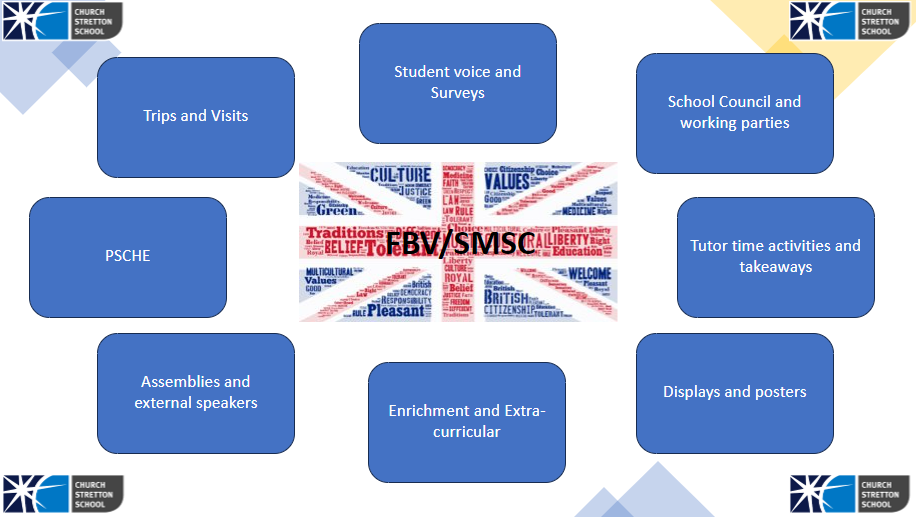
Church Stretton school has a strong commitment to the personal and social development of all stakeholders. The school vision and values, created by staff, learners and parents supports spiritual, moral, social and cultural characteristics in all learners.
We believe:
- SMSC is about how children and young people make sense of the world and other people; how they interact with other people; and the sort of person they are and are becoming.
- SMSC is as much about how children are taught as what they are taught.
- SMSC is not something that happens in isolation – it is linked and inter-connected to everything the school does and what kind of place it is
SPIRITUAL development as shown by our young people:
- Explore beliefs and experience
- respect faiths, feelings and values
- enjoy learning about oneself, others and the surrounding world
- use imagination and creativity
- reflect.
MORAL development as shown by our young people:
- Recognise right and wrong
- respect the law
- understand consequences
- investigate moral and ethical issues
- offer reasoned views.
SOCIAL development as shown by our young people:
- Use a range of social skills
- participate in the local community
- appreciate diverse viewpoints; participate, volunteer and cooperate
- resolve conflict
- engage with the ‘Fundamental British values‘ of democracy, the rule of law, liberty, respect and tolerance.
CULTURAL development of our young people is shown by their ability to:
- Appreciate cultural influences
- appreciate the role of Britain’s parliamentary system
- participate in culture opportunities
- understand, accept, respect and celebrate diversity
Values throughout the Curriculum